
Overview
This article explains how to import several passwords into SecureSafe Pass at once, using a CSV file. This saves time compared to adding each password manually, especially if you are moving passwords over from another password manager or a spreadsheet.
Before You Start
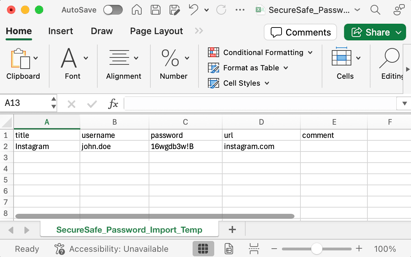
- SecureSafe Pass only reads files with these exact column headers:
title,username,password,url,comment. Download the template inside SecureSafe Pass rather than creating a file from scratch, or make sure your file's header row matches these names exactly. - If you are moving from another password manager, your exported file will use different column names. See "Coming From Another Password Manager" below before you continue.
Coming From Another Password Manager
Your exported file will use different column headers than SecureSafe Pass expects, so you need to rename its header row before uploading it. Two things make this easier than it sounds:
- Column order does not matter. Only the header names need to match. You can rename the headers in place without moving any columns around.
- Extra columns are simply ignored. If your export has additional columns SecureSafe Pass does not use, such as a folder, category, or favorite flag, you do not need to delete them. They will not be read or imported, and they will not cause the import to fail.
To convert a file, open it in a spreadsheet program and rename the header row using the table for your password manager below. Then save it as a CSV file and continue with the steps in the next section.
LastPass
| Your file's header | Rename to |
|---|---|
| name | title |
| username | username |
| password | password |
| url | url |
| extra | comment |
Leave totp, grouping, and fav as they are. They will be ignored.
Bitwarden
| Your file's header | Rename to |
|---|---|
| name | title |
| login_username | username |
| login_password | password |
| login_uri | url |
| notes | comment |
Leave folder, favorite, type, fields, reprompt, and login_totp as they are. They will be ignored.
Dashlane
| Your file's header | Rename to |
|---|---|
| title | title |
| username | username |
| password | password |
| url | url |
| note | comment |
Leave username2, username3, category, and otpSecret as they are. They will be ignored.
1Password and Proton Pass
These two do not export a single, fixed set of column headers, the exact columns can vary by version and platform. Open your exported file and check its header row directly. Rename whichever columns hold the item name, website, username, password, and notes to title, url, username, password, and comment. Any other column can be left as is and will be ignored.
Note: After renaming, always check that a title, username, password, url, and comment column exist somewhere in your file, spelled exactly as shown and in lowercase. Missing or misspelled headers are the most common reason an import fails.
Import Your Passwords
1. Click your Profile Icon in the upper right corner. 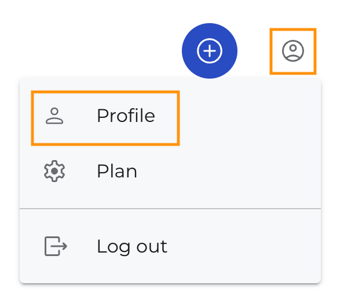
2. Select Password from the menu, then click Import Password. 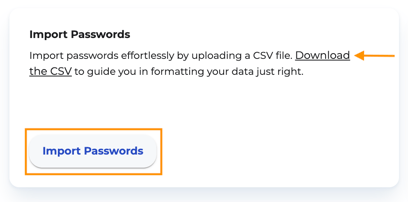 3. Click Download Template to get the CSV template formatted for SecureSafe Pass.
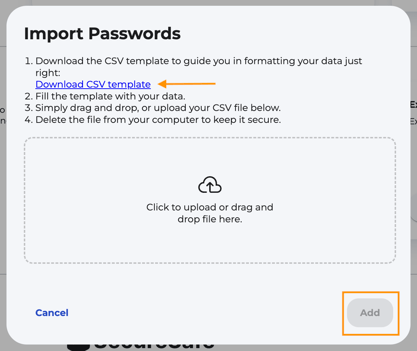
Note: If you are moving from another password manager, use the "Coming From Another Password Manager" section above to rename your file's headers instead of starting from a blank template.
4. Open the template and enter your password data, one row per password. Save the file when you are finished.
5. Drag and drop the saved file into the upload area, or click it to browse and select the file from your computer.
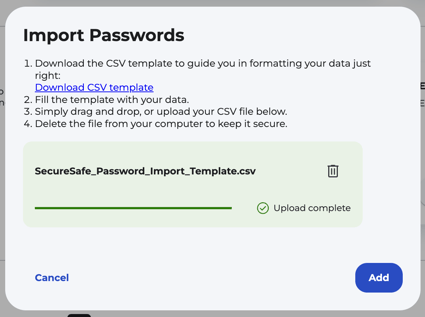
6. Click Add to upload the file.
7. On the next screen, check the column mapping. This tells SecureSafe Pass which column in your file corresponds to which field, such as website, username, and password. Correct any column that has been mapped to the wrong field.
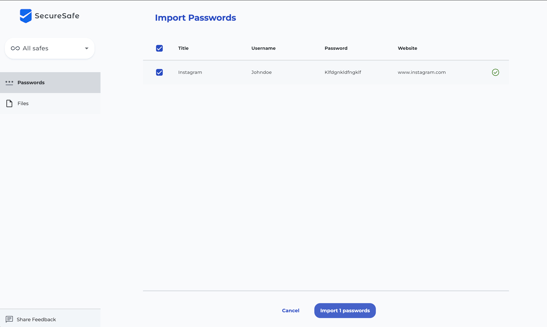
8. Review the list of passwords found in your file. Deselect any entries you do not want to import.
9. Click Import X passwords to complete the import, where X is the number of passwords selected.
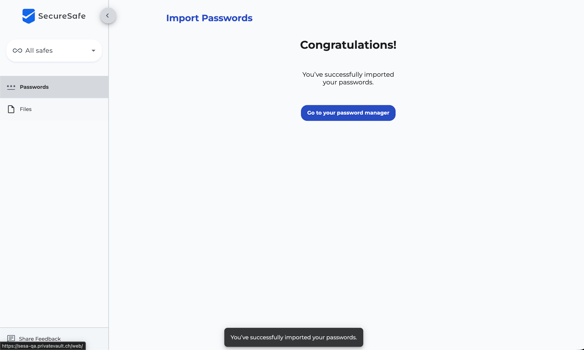
10. Once the import finishes, click Go to your password manager.
What Happens Next
Your imported passwords now appear in your password overview alongside your existing SecureSafe Pass entries.
Need Help
If a password fails to import, check that the file still matches the column headers from the original template. If the issue continues, contact SecureSafe Support.